THE NON FLUFF EMOTIONAL STUFF™

Above or Below the Line?

There is a simple question that can completely shift the way we move through life:
“Am I looking for excuses or solutions?”
It may sound simple, but if we are honest with ourselves, this one question can reveal a lot.
Because every day, in small and big ways, we are given opportunities to either live below the line or above the line.
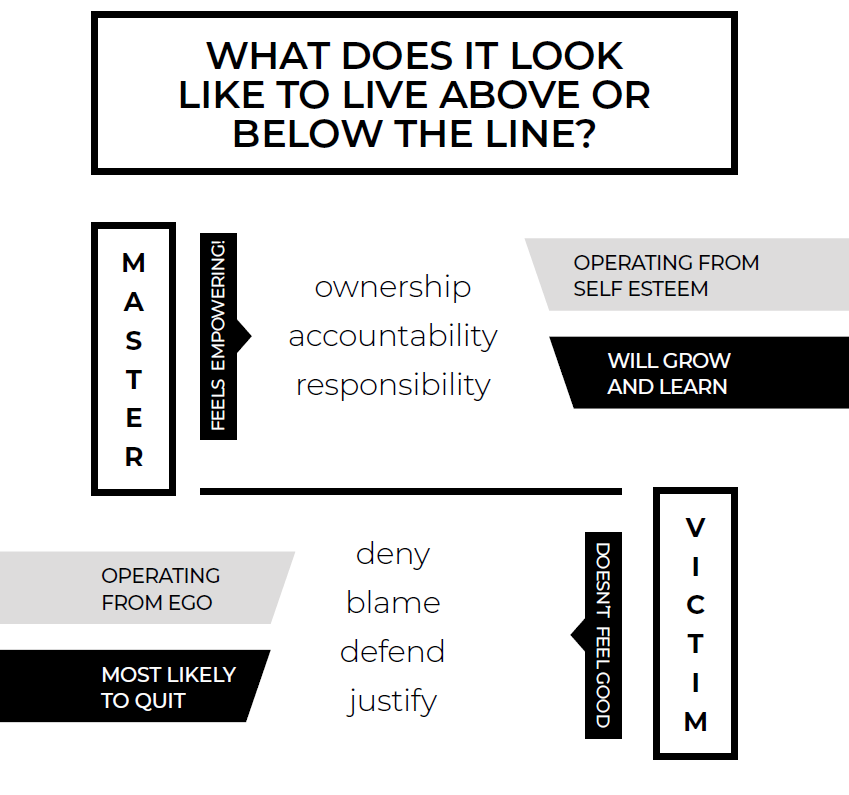
Below the line is where we blame, justify, defend and deny.
Above the line is where we take ownership, accountability and responsibility.
And the beautiful thing is, we get to choose where we stand.
Not perfectly.
Not every moment.
But again and again, we get the chance to move from reaction to creation.
What Does It Mean to Live Below the Line?
Living below the line doesn’t make us bad.
It makes us human.
We all slip there.
We all have moments when we want to blame someone else, defend our behaviour, justify why we can’t change or deny what is really going on.
Below the line sounds like:
“It’s not my fault.”
“I can’t help it.”
“They made me feel this way.”
“I wouldn’t have reacted like that if they didn’t do what they did.”
“I can’t change because of my circumstances.”
“There’s no point trying.”
“No one understands how hard this is.”
Now, some of those feelings may be understandable.
Life can be hard.
People can disappoint us.
Things do happen outside of our control.
But when we stay below the line, we become stuck in the problem.
We start looking for evidence of why we can’t move forward.
We hand our power to the situation, the person, the past, the timing, the economy, the workload, the family history, the childhood, the boss, the partner, the friend, the traffic, the email, the weather.
And while some of those things may absolutely impact us, they do not have to own us.

The Victim Mindset
The victim mindset says:
“Life is happening to me.”
It focuses on what is unfair, what is missing, what went wrong and who is to blame.
And let’s be clear, there may be real pain there.
This is not about dismissing what someone has been through.
It is not about saying, “Just be positive.”
That is not what we do here.
This is the non-fluff emotional stuff.
The victim mindset is not about whether you have experienced hard things.
It is about whether those hard things are now running your life.
It is about whether you have given your future to your past.
It is about whether you are waiting for everything outside of you to change before you allow yourself to take one small step forward.
And this is where we have to be lovingly honest with ourselves.
Because we can validate our pain without building a home inside it.
What Does It Mean to Live Above the Line?
Living above the line means we move into ownership, accountability and responsibility.
It sounds like:
“This is hard, and I can still choose my next step.”
“I don’t like what happened, but what can I learn from it?”
“I feel triggered, so what is this showing me?”
“I reacted in a way I’m not proud of, so how can I repair it?”
“I can’t control them, but I can control how I respond.”
“This didn’t work, so what could I try differently?”
“What support do I need?”
“What is within my control?”
Above the line is not about pretending everything is okay. It is about deciding that we will not abandon our own power just because something feels hard. It is the place where we stop pointing outward and start looking inward.
Not with blame.
With curiosity.
Not with shame.
With honesty.
Not with punishment.
With responsibility.

The Creator Mindset
The creator mindset says:
“Life is not always easy, but I have choices.”
A creator does not need perfect circumstances to begin.
A creator does not wait for everyone else to change before they take action.
A creator does not deny the difficulty, but they also do not let the difficulty become the whole story.
A creator asks better questions.
Instead of:
“Why does this always happen to me?”
They ask:
“What can I learn from this?”
Instead of:
“Why won’t they change?”
They ask:
“What boundary do I need to set?”
Instead of:
“I can’t do this.”
They ask:
“What is one small step I can take?”
Instead of:
“This is impossible.”
They ask:
“What support, skill or mindset shift would help me move forward?”
Can you feel the difference?
One keeps us circling.
The other creates movement.
Excuses or Solutions?
This is where our takeaway question becomes so powerful:
“Am I looking for excuses or solutions?”
Excuses often feel comforting in the moment because they protect us from responsibility.
They let us stay where we are.
They give us a reason not to try.
They help us avoid the discomfort of change.
But they also keep us stuck.
Solutions may feel uncomfortable at first because they ask something of us.
They ask us to look honestly.
They ask us to take ownership.
They ask us to have the conversation, set the boundary, change the habit, ask for help, learn the skill, apologise, try again or choose a different thought.
Solutions move us forward.
And sometimes the solution is not dramatic.
Sometimes it is simply:
“I need to rest.”
“I need to stop replaying this.”
“I need to ask for support.”
“I need to take responsibility for my reaction.”
“I need to stop telling this story.”
“I need to choose one small next step.”
Small steps count.
Small shifts count.
Small moments of ownership count.
We Don't Live Above the Line All the Time
No one lives above the line every moment of every day. And if they tell you they do, they are probably very much below the line and denying it!
We all get triggered.
We all fall into blame.
We all justify our behaviour at times.
We all defend ourselves when something feels uncomfortable.
The goal is not perfection.
The goal is awareness.
Can you notice when you have slipped below the line?
Can you pause before making it worse?
Can you ask yourself a better question?
Can you gently bring yourself back to ownership?
That is the practice.
Not never falling below the line.
But learning how to climb back above it.
How to Move Above the Line
If you notice yourself blaming, justifying, defending or denying, try this simple reset:
1. Pause and name it
“I think I’m below the line right now.”
No shame.
Just awareness.
2. Accept what is
“This is what is happening right now.”
Acceptance does not mean approval.
It simply means you stop fighting the reality of the moment so you can respond more clearly.
3. Ask a quality question
“What can I take responsibility for here?”
“What is within my control?”
“What is one small step I can take?”
4. Choose one action
Take the step.
Send the message.
Have the conversation.
Write it out.
Breathe.
Walk away.
Ask for help.
Change the thought.
Do one thing that moves you from reaction to creation.

The Power of Self-Honesty
Living above the line requires self-honesty.
Not harsh honesty.
Not the kind where we attack ourselves and list all the ways we are failing.
Loving honesty.
The kind that says:
“I can see I’m blaming right now.”
“I can see I’m making excuses.”
“I can see I’m defending instead of listening.”
“I can see I’m waiting for someone else to fix how I feel.”
“I can see I have a choice here.”
That kind of honesty is powerful because it brings us back into our own life.
It reminds us that we are not powerless.
It reminds us that even if we cannot control the whole situation, we can control the next thought, the next response, the next action.
Reflection Questions
Take a moment to check in with yourself.
-
Where in your life have you been living below the line?
-
Where have you been blaming, justifying, defending or denying?
-
What excuse have you been holding onto?
-
What solution might be available to you?
-
What is one thing you can take responsibility for today?
-
What would the creator version of you do next?

Final Thoughts
Every day gives us opportunities to move from reaction to creation.
To move from blame to ownership.
From excuses to solutions.
From waiting to choosing.
From below the line to above the line.
And remember, this is not about blaming yourself for where you are.
It is about remembering that you have more power than you think.
So the next time you feel stuck, pause and ask:
“Am I looking for excuses or solutions?”
That one question might be the doorway back to your power.


Written by Alisa Pettit
It’s never too late for a lane change. Insite Mind is the brainchild of one woman who after a decade spinning in the hamster wheel of the accounting world gave it up to live out her heart work. But it didn’t come without challenge and a little nudge from the universe in the form of a book Dealing with Difficult People. Upon opening it Alisa was surprised to find in black and white text “maybe it’s you”. So after several ego deaths and many personal development books along the way Alisa Pettit found her way to coaching. Now a fully fledged positive mindset coach and personal mastery guru Ali’s work helps people find their way through mindset teachings.
CHECK OUT OUR MOST POPULAR BLOGS

Make the Most of Your Journaling Process

How & Why Should I Use Affrimations

How to Not Yell (Or Suppress!) In Times of Stress

Self Care Myths... #BUSTED!

5 Simple Ways To Kickstart Your Day (And Your Positivity!)

4 Ways You're Killing Your Confidence
Why Your New Year's Resolutions Fall Flat On Their Face

A Winter Solstice Reflection
For all general inquiries, please contact us at hello@insitemind.com.au
© Copyright. All rights reserved.