THE NON FLUFF EMOTIONAL STUFF™

Stop Giving Away Your Power
There is a moment in all of our lives when we realise something very uncomfortable, but also incredibly freeing.
No one can make us feel anything.
Now, before you close the page and think, “Well, that’s not true, because you should have met that person who cut me off in traffic, spoke to me like that, ignored my message or completely pushed my buttons,” stay with me.
Because this is not about pretending people don’t affect us.
They do.
People can trigger us.
Situations can challenge us.
Life can bring us moments that feel unfair, frustrating, disappointing and deeply uncomfortable.
But there is a big difference between being triggered by something and handing over responsibility for how we feel.
And this is where we often give away our power without even realising it.
When Happiness Has Conditions
Many of us have been taught to believe that our emotions are controlled by what is happening around us.
We think:
“I’ll feel better when they apologise.”
“I’ll be happy when my partner changes.”
“I’ll feel calm when work settles down.”
“I’ll feel confident when people approve of me.”
“I’ll feel worthy when someone recognises my effort.”
Without realising it, we place conditions on our emotional wellbeing.
We make our peace dependent on someone else’s behaviour.
We make our happiness dependent on circumstances lining up exactly the way we want them to.
We make our confidence dependent on external validation.
And while it is completely human to want life to feel easier, the problem is that when we believe other people are responsible for how we feel, we hand over our power.
We start waiting.
Waiting for them to change.
Waiting for the situation to improve.
Waiting for life to be less hard.
Waiting for someone else to do something so that we can finally feel okay.
But what if your power was never meant to sit in someone else’s hands?

Responsibility Is Not Blame
Let’s be really clear about something.
Taking responsibility for your emotions does not mean blaming yourself.
It does not mean saying that what happened was okay.
It does not mean ignoring hurtful behaviour.
It does not mean pretending that painful situations didn’t affect you.
Responsibility is not blame.
Responsibility is power.
Blame says:
“This is happening because of them, and I can’t feel better until they change.”
Responsibility says:
“This has affected me, and I get to choose how I respond from here.”
Can you feel the difference?
Blame keeps us stuck.
Responsibility gives us movement.
Blame waits for someone else to fix it.
Responsibility asks, “What can I do now?”
Blame hands away power.
Responsibility brings it home.
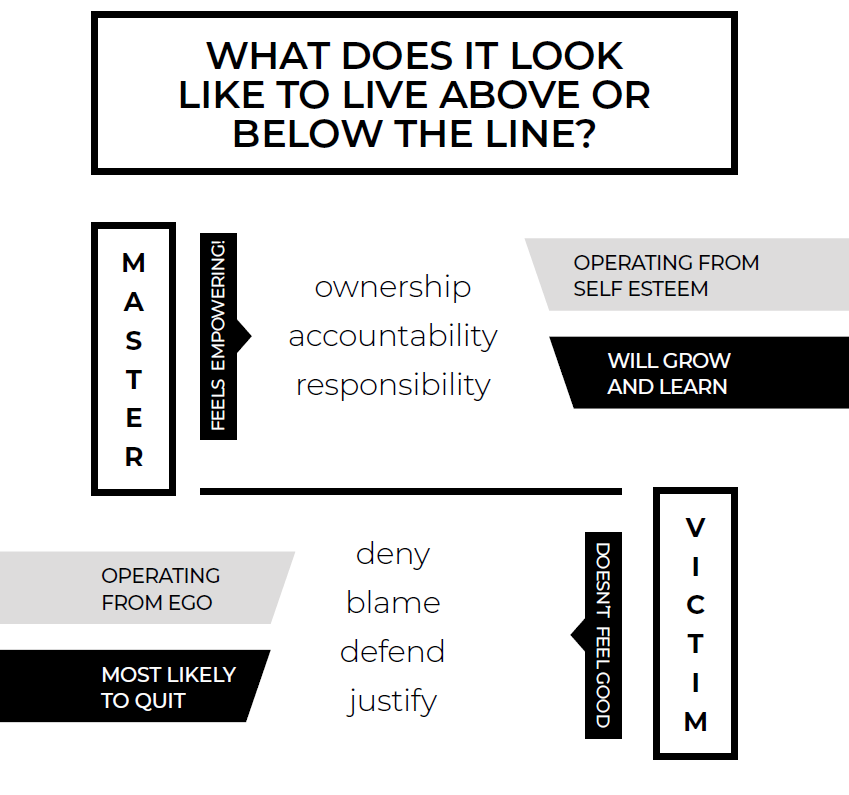
Below The Line
At Insite Mind, we often talk about living above or below the line.
When we are below the line, we tend to blame, deny, justify and defend.
We might say things like:
“I’m only angry because they did that.”
“I can’t be happy until this changes.”
“It’s not my fault I feel this way.”
“They made me react like that.”
“I wouldn’t be like this if people treated me better.”
Now, we have all been there.
Every single one of us has slipped below the line.
This is not about judging ourselves for it.
It is about noticing when it happens.
Because when we live below the line, we often feel powerless. We can become caught in the problem, focused on what others are doing, not doing, saying or not saying.
And from that place, it becomes very hard to move forward.
We are stuck pointing outward.
But our power lives inward.
Above The Line
Above the line is where we take ownership, accountability and responsibility.
This does not mean we suddenly love the situation.
It means we stop giving it complete control over us.
Above the line sounds like:
“This has triggered me, so what is it showing me?”
“I feel hurt, so what do I need right now?”
“I feel angry, so what boundary may need attention?”
“I feel disappointed, so what expectation was I holding?”
“I feel overwhelmed, so what support do I need to ask for?”
“I don’t like what happened, but I can choose my next step.”
Above the line is not always easy.
Sometimes we have to climb there slowly.
Sometimes we need to feel what we feel first.
Sometimes we need to breathe, cry, write, walk, talk to someone safe or simply take space.
But when we come back to ownership, we come back to ourselves.
That is where our power is.
The Trigger Is The Doorway
The people who trigger us often show us something important.
That doesn’t mean their behaviour is right.
It doesn’t mean we excuse things that are hurtful, disrespectful or unhealthy.
But our emotional reaction can give us information.
If someone’s comment makes you feel small, it may be showing you an old belief about not being good enough.
If someone’s behaviour makes you feel resentful, it may be showing you where you are overgiving.
If someone’s silence makes you feel anxious, it may be showing you where you are seeking certainty outside of yourself.
If someone’s criticism makes you feel defensive, it may be showing you where you are still learning to back yourself.
The trigger is not always the problem.
Sometimes the trigger is the doorway into deeper self-awareness.
This is the non-fluff emotional stuff.
It is not about blaming others.
It is not about blaming yourself.
It is about learning from what is being activated inside you.

Taking Your Power Back
So how do we stop giving away our power?
We begin by noticing our language.
When you hear yourself saying:
“They made me feel…”
Pause.
Try replacing it with:
“When that happened, I felt…”
That small shift matters.
“They made me feel rejected” becomes:
“When they didn’t reply, I felt rejected.”
“They made me angry” becomes:
“When they spoke to me that way, I felt angry.”
“They ruined my day” becomes:
“When that happened, I felt disappointed, and I’m choosing how I move through the rest of my day.”
This is not just wordplay.
This is emotional ownership.
It reminds us that something may have triggered the feeling, but we still have power in how we respond.
Acceptance Is the First Step
One of the ways we move above the line is by accepting what is.
Not liking it.
Not approving of it.
Not pretending it doesn’t matter.
Just accepting that, in this moment, it is what it is.
When we resist reality, we often add another layer of suffering.
We argue with what has already happened.
We replay it.
We wish it was different.
We mentally fight the moment over and over again.
But acceptance allows us to stop wrestling with what is already here.
It gives us a neutral place to stand.
From there, we can ask better questions.
“What can I take responsibility for here?”
“What is within my control?”
“What do I need?”
“What boundary do I need to set?”
“What thought would help me move forward?”
“What is the next best step?”
Questions move us forward.
Blame keeps us circling.

You Can Feel It and Still Choose
Taking responsibility for your emotions does not mean you will never feel angry, hurt, sad or disappointed.
You are human.
You are allowed to feel.
The goal is not to become emotionless.
The goal is to stop handing the steering wheel of your emotional life to everyone else.
You can feel hurt and still choose not to shut down.
You can feel angry and still choose your words carefully.
You can feel disappointed and still choose not to make it mean you are not worthy.
You can feel triggered and still choose to pause before reacting.
You can feel upset and still choose to come back to yourself.
This is where freedom begins.
Not when everyone around you behaves perfectly.
Not when life finally becomes easy.
Not when nothing triggers you anymore.
Freedom begins when you realise that your response belongs to you.
Reflection Questions
Take a moment to reflect honestly.
-
Where in your life have you been giving someone else power over how you feel?
-
What condition have you placed on your happiness?
-
What do you keep waiting for someone else to change?
-
What emotion has been asking for your attention?
-
What would taking responsibility look like in this situation?
-
What is one small way you can bring your power back today?

Final Thoughts
People will trigger us.
Life will challenge us.
Things will not always go the way we hoped.
But we do not have to give away our power every time something uncomfortable happens.
We can pause.
We can feel.
We can listen.
We can take responsibility.
And we can choose how we respond.
Responsibility is not blame.
Responsibility is power.
And the moment you stop waiting for everyone else to change before you allow yourself to feel better, you begin to come home to yourself.
That is where your power has been all along.


Written by Alisa Pettit
It’s never too late for a lane change. Insite Mind is the brainchild of one woman who after a decade spinning in the hamster wheel of the accounting world gave it up to live out her heart work. But it didn’t come without challenge and a little nudge from the universe in the form of a book Dealing with Difficult People. Upon opening it Alisa was surprised to find in black and white text “maybe it’s you”. So after several ego deaths and many personal development books along the way Alisa Pettit found her way to coaching. Now a fully fledged positive mindset coach and personal mastery guru Ali’s work helps people find their way through mindset teachings.
CHECK OUT OUR MOST POPULAR BLOGS

Make the Most of Your Journaling Process

How & Why Should I Use Affrimations

How to Not Yell (Or Suppress!) In Times of Stress

Self Care Myths... #BUSTED!

5 Simple Ways To Kickstart Your Day (And Your Positivity!)

4 Ways You're Killing Your Confidence
Why Your New Year's Resolutions Fall Flat On Their Face

A Winter Solstice Reflection
For all general inquiries, please contact us at hello@insitemind.com.au
© Copyright. All rights reserved.