THE NON FLUFF EMOTIONAL STUFF™

The Story You Keep Telling Yourself
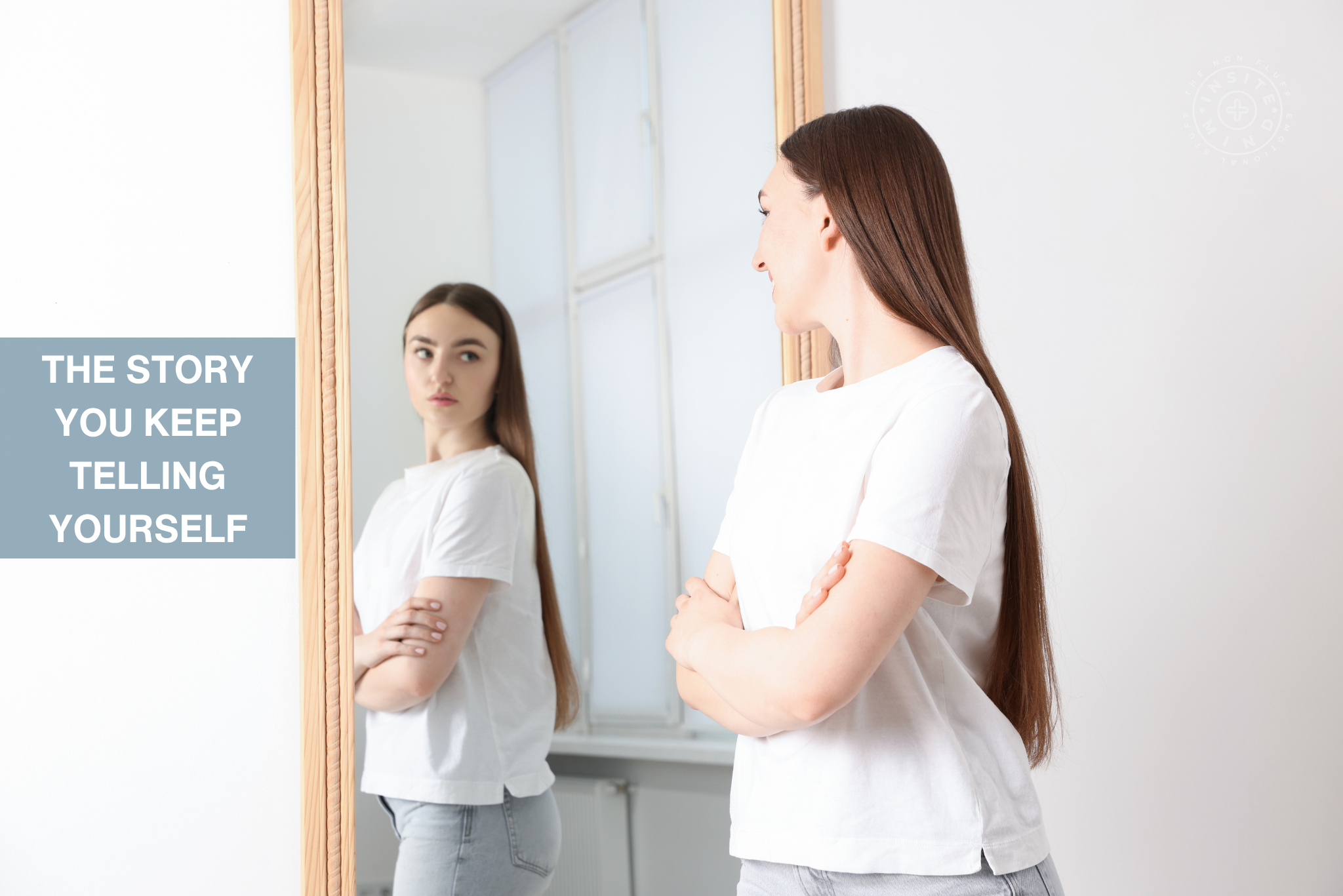
We all have a story.
Actually, we have lots of them.
Stories about who we are.
Stories about what we are capable of.
Stories about why things happened.
Stories about what always happens to us.
Stories about what we can and can’t do.
And the interesting thing is, we tell these stories so often that eventually we stop seeing them as stories.
We start seeing them as facts.
“I’m just not confident.”
“I’ve never been good with money.”
“I always choose the wrong people.”
“I’m terrible at sticking to things.”
“I’m not creative.”
“I always mess things up.”
“People like me don’t do things like that.”
“That’s just who I am.”
But is it?
Or is it simply a story you have repeated so many times that it has started to feel like the truth?
The Story Becomes the Lens
Our personal story is usually built from a collection of experiences, memories, beliefs and meanings we have gathered over time.
Something happens.
We decide what it means.
We repeat that meaning.
And eventually it becomes part of how we see ourselves.
Maybe you struggled at school and somewhere along the way decided:
“I’m not smart.”
Maybe a relationship ended and you decided:
“I’m hard to love.”
Maybe you tried something once and it didn’t work, so the story became:
“I’m not somebody who succeeds at things like that.”
Maybe someone criticised you years ago, and you are still carrying their words as part of your identity today.
The experience may have happened once.
But the story can be repeated thousands of times.
And every time we repeat it, we strengthen it.

Your Past Is Not Your Identity
There is an important difference between something that happened to you and who you are.
You may have failed at something.
That does not make you a failure.
You may have made a poor decision.
That does not mean you make poor decisions.
You may have stayed too long in the wrong relationship.
That does not mean you are destined to repeat the pattern forever.
You may have lacked confidence in the past.
That does not mean “unconfident” is who you are.
But sometimes we take an experience and turn it into an identity.
“I failed” becomes:
“I’m a failure.”
“I procrastinated” becomes:
“I’m a procrastinator.”
“I didn’t follow through” becomes:
“I never finish anything.”
“I was scared” becomes:
“I’m not brave.”
Can you see the difference?
One describes something that happened.
The other decides who you are.
And once we decide who we are, we unconsciously start looking for evidence to prove ourselves right.
We Find Evidence for the Story We Believe
If your story is:
“Nothing ever works out for me,”
you will notice every disappointment.
Every setback.
Every plan that changes.
Every moment that appears to confirm your story.
But you may completely overlook the things that did work.
The people who showed up.
The opportunities that appeared.
The problems you solved.
The times you adapted.
The things you have already overcome.
Our stories create a filter.
We see the parts of life that match what we already believe.
And that is why changing the story matters so much.

Be Careful With "I Am"
There are two tiny words that carry enormous power:
“I am.”
Think about how often you finish that sentence without even noticing.
“I am hopeless.”
“I am too old.”
“I am awkward.”
“I am bad at this.”
“I am unlucky.”
“I am not good enough.”
Every time we use “I am”, we are making an identity statement.
We are telling ourselves:
“This is who I am.”
But what if you became more deliberate about what comes next?
“I am learning.”
“I am growing.”
“I am becoming more confident.”
“I am figuring this out.”
“I am capable of doing difficult things.”
“I am allowed to change.”
“I am becoming someone who follows through.”
That does not mean choosing words you don’t believe.
It means refusing to keep reinforcing an identity you no longer want.
Stop Retelling the Old Version
Sometimes we keep an old version of ourselves alive simply because we keep talking about it.
We tell friends.
We tell family.
We tell ourselves.
“I’ve always been like this.”
“That’s just what I do.”
“You know me, I always…”
And every time we tell the story, we breathe a little more life into it.
But you are allowed to evolve.
You are allowed to outgrow the person you were five years ago.
Or five months ago.
Or five minutes ago.
You are allowed to say:
“That was who I was then. It does not have to be who I am now.”
That does not mean denying your past.
Your past matters.
It has shaped you.
It has taught you.
But it does not have to dictate the next chapter.

Whose Story Are You Carrying?
Sometimes the story we tell about ourselves did not even begin with us.
Maybe you heard:
“You’re too sensitive.”
“You’re the shy one.”
“You’re not academic.”
“You’ve never been good with money.”
“You’re just like your father.”
“You’re not the sporty one.”
“You always give up.”
And somewhere along the way, somebody else’s observation became your identity.
But just because someone said it does not make it true.
And just because it may have been true once does not mean it has to remain true.
So ask yourself:
“Where did this story come from?”
“Who taught me to believe this?”
“Does it still fit?”
And most importantly:
“Do I want to keep carrying it?”
You Can Choose a New Story
Changing your story does not mean making something up.
It does not mean pretending your past never happened.
It means choosing which parts of your story you continue to give power to.
Instead of:
“I’ve failed so many times.”
Try:
“I’ve been willing to try many times.”
Instead of:
“I never finish anything.”
Try:
“I am learning how to follow through.”
Instead of:
“I’m terrible with change.”
Try:
“Change has challenged me before, and I have still found my way through.”
Instead of:
“People always let me down.”
Try:
“I am learning to choose relationships that feel safe and reciprocal.”
Instead of:
“I’m not confident.”
Try:
“I am building confidence every time I back myself.”
Notice that these new stories do not deny reality.
They widen it.
They allow growth into the conversation.

Tell the Story of Who You Are Becoming
We spend a lot of time telling stories about who we have been.
What if we started telling more stories about who we are becoming?
What if instead of constantly referring back to your past for evidence of what is possible, you began looking forward?
Ask yourself:
Who do I want to become?
How does that version of me think?
How does she speak to herself?
What does she believe?
What does she no longer apologise for?
What does she stop tolerating?
What does she start doing?
How does she respond when life gets difficult?
Then start telling that story.
Not someday.
Now.
“I am becoming someone who trusts herself.”
“I am learning to speak up.”
“I am becoming someone who keeps promises to herself.”
“I am creating a life that feels more aligned with who I am.”
“I am learning that I can do things differently.”
That is not pretending.
That is direction.
Listen to the Stories You Tell Other People
Here is an interesting challenge.
Listen to yourself when you talk about your life.
Do you repeatedly tell the same negative stories?
The same relationship story?
The same work story?
The same money story?
The same story about your body?
The same story about why you can’t?
The same story about the person who hurt you?
There is a difference between processing an experience and continually rehearsing it.
Sometimes we need to talk things through.
But eventually we also need to ask:
“Is repeating this helping me heal, or is it keeping me connected to an identity I am ready to leave behind?”
This is the non-fluff emotional stuff.
We honour what happened.
And then we decide what happens next.

Rewrite the Story
Think of one story you regularly tell about yourself.
Write it down exactly as you normally say it.
Maybe it is:
“I’ve never been confident.”
Now ask:
Is this completely true?
Can I think of moments when it wasn’t true?
What evidence have I been ignoring?
What have I learned since this story began?
Who am I becoming now?
Then rewrite it.
“I have had times when I lacked confidence, but I am learning to trust myself and speak up more.”
Feel the difference?
You are not erasing the past.
You are simply refusing to let one chapter become the title of the whole book.
Reflection Questions
Take some time to honestly reflect:
-
What story do I repeatedly tell about myself?
-
Where did that story begin?
-
What evidence do I keep using to support it?
-
What evidence exists that contradicts it?
-
Is this story still true?
-
Is this story helping me grow?
-
Who would I be without this story?
-
What new story would better reflect the person I am becoming?
And finally:
-
Is this story helping me become who I want to be?

Final Thoughts
You cannot change everything that has happened in your story.
There are chapters you would never have chosen.
There may be moments you wish you could rewrite.
There may be experiences that shaped you deeply.
But the story is not finished.
And you still have a say in what comes next.
You can keep repeating the old version.
Or you can begin telling a story that leaves room for growth, possibility and change.
You are not only the character in your story.
You are also the author of what comes next.
So listen closely to the story you are telling yourself.
And ask:
“Is this story helping me become who I want to be?”
If the answer is no, perhaps it is time to start writing a new chapter.


Written by Alisa Pettit
It’s never too late for a lane change. Insite Mind is the brainchild of one woman who after a decade spinning in the hamster wheel of the accounting world gave it up to live out her heart work. But it didn’t come without challenge and a little nudge from the universe in the form of a book Dealing with Difficult People. Upon opening it Alisa was surprised to find in black and white text “maybe it’s you”. So after several ego deaths and many personal development books along the way Alisa Pettit found her way to coaching. Now a fully fledged positive mindset coach and personal mastery guru Ali’s work helps people find their way through mindset teachings.
CHECK OUT OUR MOST POPULAR BLOGS

Make the Most of Your Journaling Process

How & Why Should I Use Affrimations

How to Not Yell (Or Suppress!) In Times of Stress

Self Care Myths... #BUSTED!

5 Simple Ways To Kickstart Your Day (And Your Positivity!)

4 Ways You're Killing Your Confidence

Why Your New Year's Resolutions Fall Flat On Their Face

A Winter Solstice Reflection
For all general inquiries, please contact us at hello@insitemind.com.au
© Copyright. All rights reserved.